
What Is a Facet Joint?
A facet joint is a small paired joint at the back of the spine that connects neighboring vertebrae and guides controlled movement. Each joint has smooth cartilage and a surrounding capsule. Facet joints help the spine bend, rotate, and extend while limiting excessive motion between adjacent spinal bones.
Quick Facts About Facet Joint
Category
Spinal synovial joint
Used for
Guiding and limiting spinal motion
Common confusion
Often confused with intervertebral discs
Also called
Zygapophyseal joint
Often discussed with
Chiropractic Adjustment
Key Takeaways About Facet Joint
- Facet joints sit behind the main spinal column.
- Their surfaces guide movement between adjacent vertebrae.
- Facet joints are not the same as spinal discs.
How Facet Joint Works
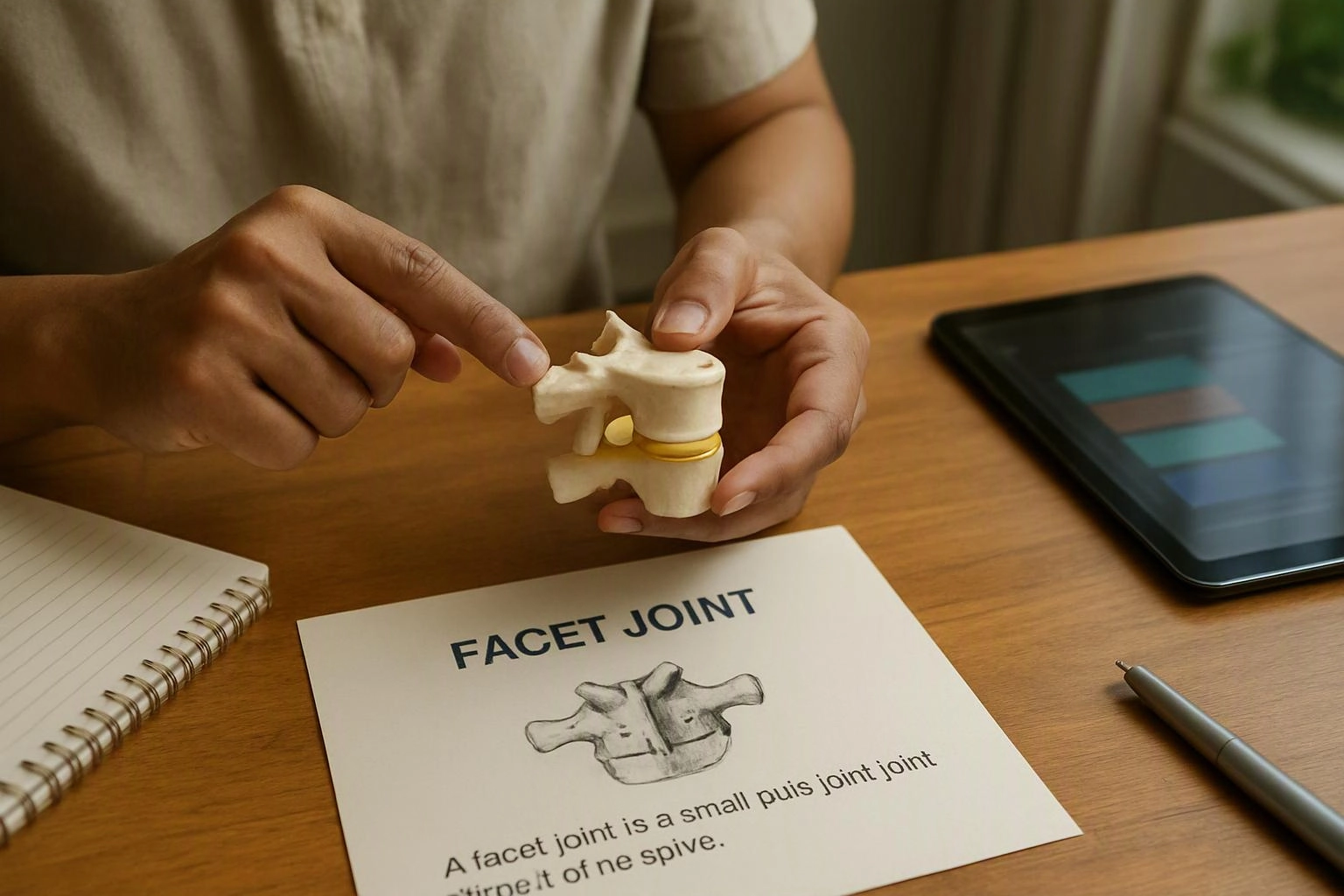
A facet joint works as a guided connection between the back portions of neighboring vertebrae. Its cartilage-covered surfaces move against each other, while the joint capsule helps contain and support the connection. Small changes in joint position can influence how nearby spinal segments bend or rotate.
Related glossary terms: Joint Mobility, Lumbar Spine, Cervical Spine.
Intervertebral discs sit between the vertebral bodies and help distribute load through the front portion of the spine. Facet joints share movement control with the discs, ligaments, and surrounding muscles. During a chiropractic adjustment, the clinician considers joint motion, muscle tension, posture, and the person’s reported symptoms before selecting an appropriate approach.

From the Advanced Injury Care Clinic team
When we assess a facet joint during a Chiropractic Adjustment visit, we consider the person’s movement pattern, spinal region, muscle response, and symptom location. Our team uses that information to distinguish a restricted joint from discomfort that may involve discs, nerves, or surrounding soft tissue.
Facet Joint in Practice: A Real-World Example
A person may report localized low back discomfort that increases during extension or rotation. During a Chiropractic Adjustment evaluation, the practitioner may examine nearby joint motion and muscle tension before deciding whether a facet joint is part of the overall presentation.
Related Services
Related Terms
Joint Mobility
Joint Mobility is the available movement at a joint and the ease with which that joint…
Lumbar Spine
Lumbar Spine is the lower section of the vertebral column, located between the thoracic spine and…
Cervical Spine
Cervical Spine is the upper section of the spinal column that supports the head and connects…
Range of Motion
Range of Motion is the amount a joint can move through its available directions. Clinicians assess…
Advanced Injury Care Clinic
Have Questions About Facet Joint?
Contact Advanced Injury Care Clinic for practical guidance on Facet Joint and related chiropractor work in Brentwood.