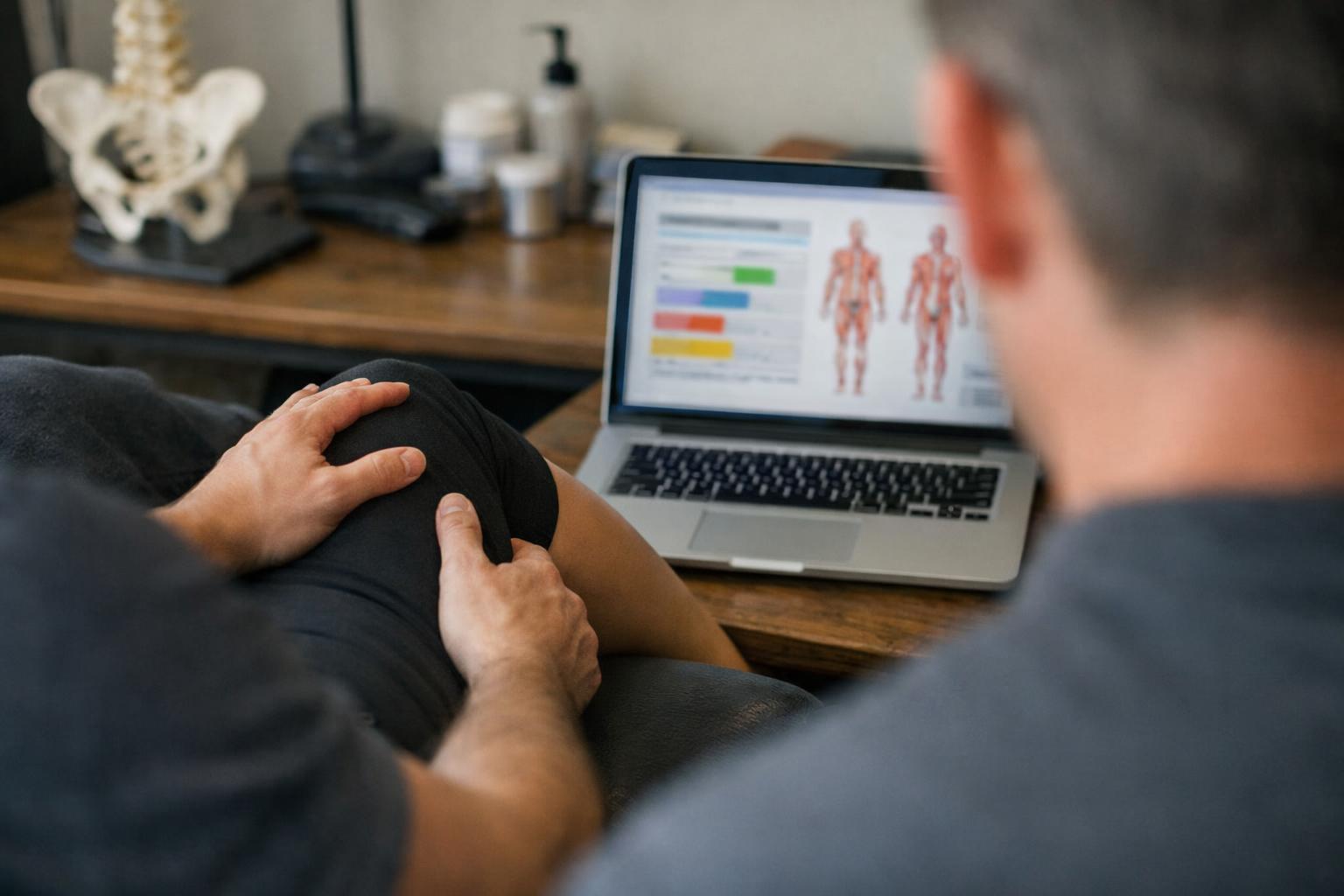
Muscle Energy Technique is a hands-on therapy that uses the patient’s own gentle muscle contractions to improve joint mobility, reduce pain. And restore normal movement. The chiropractor positions the joint near its restricted barrier, asks the patient to contract a specific muscle for a few seconds, then repositions the joint to a new barrier, repeating the process until full motion is restored.
Category
Manual therapy
Used for
Joint stiffness, muscle tightness, post-injury recovery
Common confusion
Often mistaken for passive stretching or high-velocity adjustments
Also called
MET, Muscle Energy Therapy
Often discussed with
Car Accident Injury Treatment, Work Injury Treatment

MET is short for Muscle Energy Technique. It is a type of hands-on treatment. The patient helps by moving their muscles.
Related glossary terms: Chiropractic Adjustment, Flexion Distraction, Sacroiliac Joint Dysfunction.
Most treatments push joints for you. MET asks you to push back gently. This helps loosen tight muscles and joints.
MET is soft and quiet. There are no sudden moves or cracking sounds. It works well for people who want gentle care.
Doctors called osteopaths made MET in the 1900s. Chiropractors and therapists use it now. It works by relaxing muscles after they tighten.
This is called post-isometric relaxation. Muscles relax for a short time. Then the joint can move more without pain.
The patient controls the push. This makes MET very safe. It's good for people with weak bones or fresh injuries.
The chiropractor checks how far your joint moves. They look for stiff or tight spots. Then they put the joint near its limit.
This limit is called the restrictive barrier. You push a muscle against their hand. You push for 5 to 10 seconds.
After you relax, the joint moves a little more. The chiropractor moves it to a new limit. They do this a few times to help the joint move better.
Say your lower back feels stiff. The chiropractor turns your back near its limit. You push gently against their hand.
After you relax, your back turns a bit more. This helps tight muscles loosen. It also lines up the joint better.
MET works on many joints. It helps backs, shoulders, hips. And knees. It's a useful tool for chiropractors.

MET helps joints work better. It doesn't hurt like some treatments. You help. So you trust your body more.
It works well for muscle spasms. It helps stiff joints after injuries. It also helps tight muscles that make daily tasks hard.
MET is good for people who can't handle rough treatments. This includes older adults. It's also good for people with weak bones or recent surgery.
MET works well with other treatments. It can loosen muscles before a regular adjustment. This makes the adjustment easier.
It also works with stretches and exercises. Heat or cold therapy can help too. Together, they speed up recovery.
MET fits many people. Athletes use it for injuries. Older adults use it for arthritis stiffness.
MET helps when joints feel stuck. It helps tight muscles too. This often happens after a car crash.
Muscles tighten to protect you. MET helps them relax. It also helps after sitting too long or doing the same move over and over.
Athletes use MET after injuries. It brings back movement safely. It won't hurt them more.
MET helps a problem called sacroiliac joint dysfunction. Gentle pushes can line up the pelvis. It doesn't need rough moves.
MET is good when other treatments aren't safe. People with weak bones should avoid hard pushes. MET is a safe choice.
People recovering from surgery use MET too. It brings back movement gently. It won't hurt healing tissues.
Chiropractors can change MET for each person. They adjust the push and position. This matches what you need and feel.
Passive stretching involves the therapist moving the joint for the patient. While Muscle Energy Technique requires the patient to actively contract muscles.
HVLA adjustments use quick, forceful thrusts to move joints, whereas Muscle Energy Technique uses gentle muscle contractions and no thrusts.
PNF is a broader approach that includes Muscle Energy Technique but also involves more complex patterns of muscle contraction and relaxation.
Muscle Energy Technique is particularly effective for patients who fear traditional adjustments or have conditions like hypermobility, where gentle techniques are safer. The key is precise positioning and patient cooperation—poor technique can reduce effectiveness or cause temporary soreness.
A patient visits a chiropractor after a minor car accident and complains of a stiff neck that won’t turn fully to the right. The chiropractor uses Muscle Energy Technique by gently rotating the patient’s head to the right until resistance is felt. The patient is asked to push their head slightly back against the chiropractor’s hand for 5 seconds, then relax. After repeating this a few times, the patient finds they can turn their head further with less discomfort.
Chiropractic Adjustment is a hands-on procedure where a licensed chiropractor applies controlled force to a specific joint in the spine or other body part. The goal is to improve spinal motion, reduce nerve irritation. And restore proper function. Adjustments are often used to relieve pain, improve mobility.
Flexion Distraction is a gentle, non-surgical chiropractic technique designed to relieve spinal pain, especially from herniated discs, sciatica. And spinal stenosis. It uses a specialized table to stretch and decompress the spine, improving mobility and reducing pressure on nerves. The method combines rhythmic flexion movements with manual pressure to restore spinal function without forceful manipulation.
Sacroiliac Joint Dysfunction is a condition where the sacroiliac joints, located where the spine meets the pelvis, become painful due to improper movement or alignment. These joints support the upper body's weight and help absorb shock during walking or running. Dysfunction often causes lower back, hip. Or buttock pain that worsens with activity.
Ligament Injury is damage to the tough, fibrous bands of tissue that connect bones to other bones at joints. Ligament Injury occurs when these bands stretch too far or tear, often due to sudden twists, falls. Or impacts. Common sites include ankles, knees, wrists. And shoulders. Pain, swelling. And reduced joint stability are typical signs.
Bio-mechanics is the scientific study of how forces affect living bodies, especially muscles, bones. And joints. It combines principles of physics and biology to analyze movement, posture. And injuries. Chiropractors use bio-mechanics to understand spinal alignment, diagnose problems.
ChiropractorBrentwood.link
Contact ChiropractorBrentwood.link for practical guidance on Muscle Energy Technique and related chiropractor work in Brentwood.